


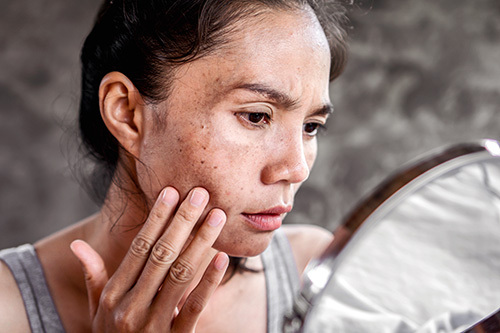
July is Hyperpigmentation and Melasma Awareness Month, making it a great time to learn about these common skin conditions. It is completely normal to see some changes in your skin tone, and most types of pigmentation are not a sign of any health issue.
These conditions are very common worldwide and happen to people of all ages and skin types. While they usually aren’t harmful, they can affect your confidence and quality of life. Nearly half of people worldwide have some kind of pigmentation disorder, and women are affected more often than men.
Many people use these terms interchangeably, but melasma and hyperpigmentation are actually different. Understanding that difference can help you pick the right treatment and decide when to see a dermatologist.*
What’s Hyperpigmentation?
If you’ve ever seen a patch of skin that looks darker than the rest, you may have wondered what hyperpigmentation is.
Hyperpigmentation is a general term for any condition that causes some areas of your skin to appear darker than your usual skin tone. It happens when your body produces too much melanin, the pigment that gives your skin, hair, and eyes their color.
These darker spots can show up almost anywhere on your body, but they’re most common in places that get a lot of sun, like your face, shoulders, chest, and hands. Depending on your skin tone, hyperpigmentation can look light brown, dark brown, gray-brown, or even blue-gray.
The good news is that most types of hyperpigmentation are harmless. However, they can sometimes show that your skin has been irritated, inflamed, or damaged by the sun over time.
Common Hyperpigmentation Types
There are several types of hyperpigmentation, each with its own cause.
Melasma is one of the most common forms of facial discoloration and often causes larger patches.
Solar lentigines, also known as age spots or sunspots, appear after years of sun exposure and are especially common with age.
Post-inflammatory hyperpigmentation (PIH) happens after your skin heals from things like acne, eczema, cuts, burns, or other injuries. Even after your skin improves, a dark spot can persist for weeks or even months.
Periorbital hyperpigmentation means having dark circles around your eyes. This can be caused by genetics, allergies, insufficient sleep, or aging.
Axillary hyperpigmentation affects the underarms and can result from repeated friction, shaving, certain skin conditions, or hormonal changes.
Because each type has different causes, it’s important to get the right diagnosis before you start any treatment.
Understanding Melasma
Melasma is one of the most well-known pigmentation disorders. It affects about 10.9% of people worldwide and around 5 million people in the United States.
Melasma usually appears as patches of brown, dark brown, or blue-gray discoloration. It most often appears on the:
- Cheeks
- Nose
- Forehead
- Upper lip
- Chin
Melasma usually affects the face, but it can also appear on other parts of the body that get a lot of sun exposure.
Unlike some other types of hyperpigmentation, melasma is usually a long-term condition. It can come and go over time, and it may get worse if you don’t protect your skin from the sun.
What Causes Melasma?
There’s no single cause of melasma. Instead, several factors usually combine to trigger it.
Sun exposure is one of the main triggers because ultraviolet (UV) rays make your body produce more melanin. Even a little sun exposure each day can make melasma darker or cause it to return after treatment.
Hormonal changes are also a big factor. Pregnancy often triggers melasma, which is why it’s sometimes called “the mask of pregnancy.” Birth control pills and hormone replacement therapy can also play a part.
Some cosmetics, skincare products, heat, and even genetics can raise your risk of getting melasma or make existing patches stand out more.
Treatments for Hyperpigmentation
The good news is that there are many effective treatments for hyperpigmentation that can help fade discoloration and improve your skin's appearance. Choose the option that best matches the type and cause of your pigmentation.
Many people begin with over-the-counter skincare products that have ingredients like:
- Vitamin C to brighten skin and help fade dark spots
- Retinol to encourage healthy skin cell turnover
- Kojic acid to reduce melanin production
- Glycolic acid to gently exfoliate the skin
- Salicylic acid to improve post-acne discoloration
- Azelaic acid to help reduce both inflammation and pigmentation
One of the most important steps is to wear a broad-spectrum sunscreen every day. Because UV exposure is a major trigger for melasma and other forms of hyperpigmentation, protecting your skin helps prevent dark spots from worsening and lowers the risk of new ones appearing.
Remember, improvement takes time. Many treatments need to be used for several weeks or even months before you see real changes.
When Should You See a Dermatologist?
At-home skincare can help, but seeing a professional often yields the best results, especially if your pigmentation doesn’t improve or keeps coming back. If that happens, make a dermatology appointment so you can move to a more targeted plan.
A dermatologist can figure out what’s causing your discoloration and make a treatment plan just for you. Depending on your skin and diagnosis, they might suggest prescription creams, chemical peels, laser treatments, or other procedures you can’t get over the counter.
If you’ve been dealing with dark spots, patches, or uneven skin tone, you don’t have to handle it by yourself. A dermatologist can help determine whether you have melasma (another form of hyperpigmentation) or another skin issue, and recommend the safest and most effective treatment for you. If your concern is ongoing, schedule a visit to get the right diagnosis and next steps.
With the right diagnosis, consistent sun protection, and a treatment plan tailored to you, many people can manage hyperpigmentation and enjoy healthier, more even skin.
*Medical Disclaimer
The information provided in this article is for general educational purposes only and is not intended as a substitute for professional medical advice, diagnosis, or treatment. Always seek the guidance of a qualified healthcare provider with any questions you may have regarding a medical condition. Dermatology Partners is not responsible for any errors, omissions, or outcomes resulting from reliance on this information.
Source
Harvard Health Publishing. (2024). Demystifying hyperpigmentation: Causes, types, and effective treatments. https://www.health.harvard.edu/diseases-and-conditions/demystifying-hyperpigmentation-causes-types-and-effective-treatments
Journal of the American Academy of Dermatology. (2024). Hyperpigmentation and Melasma Awareness Month. Journal of the American Academy of Dermatology. https://www.jaad.org/article/S0190-9622(24)02155-8/fulltext
Cleveland Clinic. (2022, September 29). Melasma. https://my.clevelandclinic.org/health/diseases/21454-melasma
UCLA Health. (n.d.). Melasma. https://www.uclahealth.org/medical-services/dermatology/conditions-treated/melasma
StatPearls Publishing. (2025). Hyperpigmentation. In StatPearls. National Center for Biotechnology Information. https://www.ncbi.nlm.nih.gov/books/NBK459271/


